



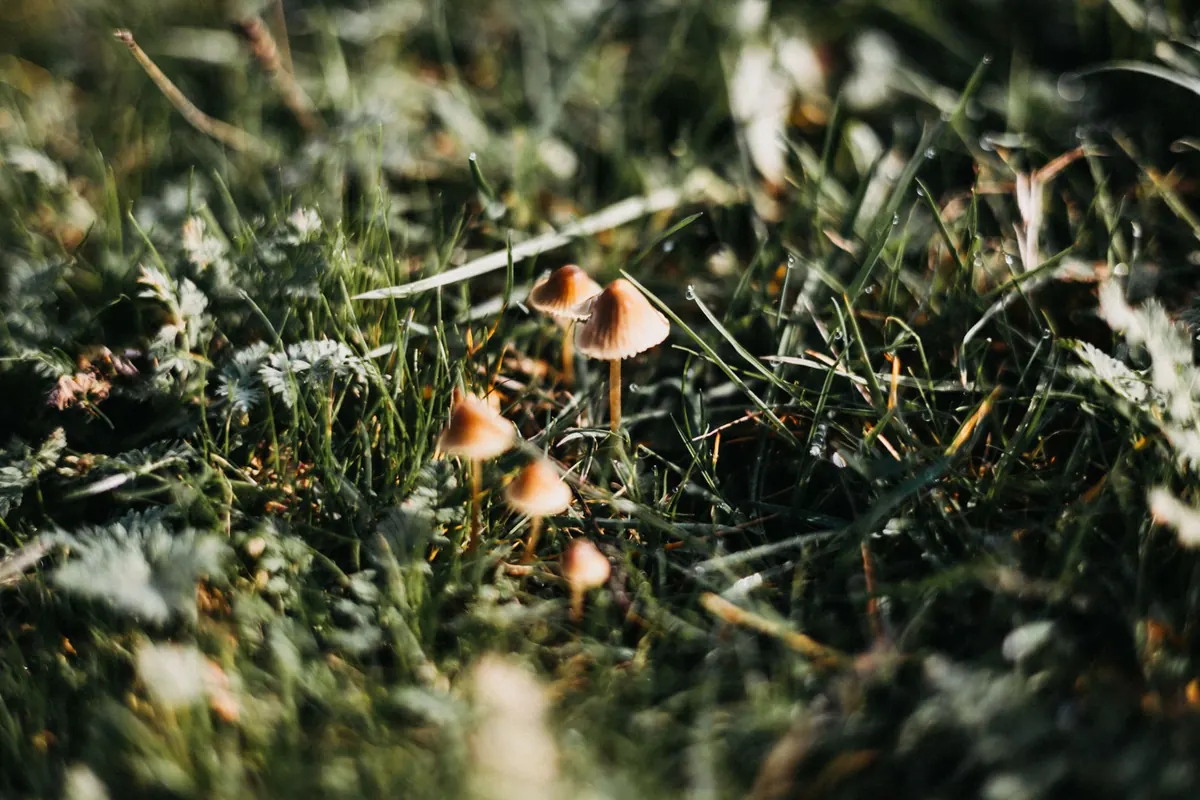
A ring of pale toadstools appears on the lawn overnight. By the weekend they have collapsed, and the grass inside the circle is a shade deeper green than everything around it. A perfect ring, gone in days, with nothing else to show for it. That is exactly the sort of event that grows stories, and the stories attached to fairy rings are among the best-travelled in Britain and Ireland. The biology underneath them is just as good.
What Is Actually Making the Ring
A fairy ring is the visible edge of a fungus that is mostly invisible. The mushrooms you notice are only the fruiting bodies — the equivalent of apples on a tree that is buried underground. The tree itself is a network of fine threads called mycelium, working through the soil or turf and digesting dead plant material.
This network began at a single point: a spore landing, or a strand spreading from a root. It then grew outward in every direction at roughly the same rate. That is why it forms a circle and keeps forming one — the middle is used up. The fungus has taken the nutrients there and moved on, so the active life sits at the rim. Growth is slow, typically measured in centimetres a year, which means a ring a few metres across may have been quietly expanding for decades. Some in old pasture are thought to be much older still.
The mushrooms push up at that outer edge, where the fungus is youngest, which is why you find a ring of them rather than a scatter. Species differ. Fairy ring champignon (Marasmius oreades) is the classic one in British turf: small, tan, wide-spaced gills, tough stem. Meadow waxcaps, several Agaricus species and a number of Clitocybe species also form rings. Some are edible, some are not, and a few will make you properly ill.
Why the Grass Changes
Rings show up in four loose patterns, and you will often see more than one in the same field:
- Lush green rings. As the fungus digests organic matter it releases nitrogen, feeding the grass at the edge. You get a band of darker, faster-growing turf — sometimes visible long before any mushroom appears.
- Rings of toadstools. Fruiting bodies at the active edge, most often in autumn, and often a day or two after rain.
- Bare or scorched rings. Behind the growing edge, the mycelium can leave soil water-repellent and short of nutrients, so in a dry spell the ring reads as dead or dusty ground.
- Combinations. One ring can look green on the shaded side and bare on the sunny side, depending on soil, drainage and how the summer has gone.
None of this is rare. Rings turn up in lawns, parks, churchyards, playing fields and golf courses. They are commonest where turf has been left undisturbed for years, which is why the biggest ones tend to be in old grazing land that has never been ploughed.
Where the Fairies Come In
For centuries, a circle of mushrooms with no obvious human cause needed an explanation, and the one most people reached for was dancing. Fairy rings were where the fairies danced at night. The mushrooms were their seats, their parasols, or the marks of their feet. The Welsh name cylch y Tylwyth Teg — the circle of the fair family — says it plainly. In Ireland and Scotland the same idea runs through the stories, with the ring treated as a doorway into somewhere else.
Worth remembering that the fairies of these traditions are not the small, kindly creatures of Victorian illustration. They are powerful, easily offended and dangerous to bargain with. That is why the advice in the old tales is nearly always the same: leave the ring alone.
The Rules of the Ring
The lore is inconsistent, and the inconsistency is part of the appeal. Widely told versions warn that stepping inside traps you: you dance until you drop, or you dance for what feels like an hour and come home to find years have passed. Others promise the opposite. Stand in a ring and you might gain the second sight, or see the fairies, or have a wish granted. Run round it nine times and something will happen — exactly what depends on who is telling it and how much they want you to try.
What the stories agree on is that the ring is a place with rules. Do not plough it up. Do not build on it. Do not cut the grass inside it, unless you fancy a run of bad luck and cows that go dry. Leave something in return for the fairies' trouble: bread and milk, an oatcake, a coin on a stone. And if you find yourself inside one, do not accept anything offered, do not eat, and do not thank anyone too warmly. The taboos around gifts, gratitude and names turn up again and again in the fairy lore of these islands.
Are Fairy Rings Dangerous?
Not in the way the stories suggest. The real risk is eating, and it is worth taking seriously.
Never eat a mushroom because a book, a website or a piece of folklore says the ring is edible. Fairy ring champignon has lookalikes, and some Clitocybe species growing in similar turf cause severe vomiting and diarrhoea. Safe identification needs several features together — gills, spore print, smell, habitat, season, and the base of the stem — and that is a skill built over years, not an afternoon. If you want to forage, go with someone experienced.
If someone has eaten a wild fungus and feels unwell — vomiting, cramps, dizziness — seek medical advice promptly rather than waiting to see how it goes, and keep a sample or clear photographs of what was eaten, including the whole stem. That last detail is more useful than most people realise.
Two smaller points. Dogs eat things in parks and lawns, so keep them moving past a ring. And wash your hands after handling fungi, and keep them away from your eyes.
How to Visit a Fairy Ring Respectfully
- Look from the edge. Fruiting bodies crush easily and may not return for weeks. The ring in the soil will still be there next year; the mushrooms might not.
- Keep off the middle. A few steps will not kill a fungus, but trampling compacts soil and flattens the very thing you came to see.
- Do not dig, feed or fix it. No fertiliser, no weedkiller, no raking the mushrooms out. In a garden, a ring is usually managed by mowing, watering and feeding the lawn so it becomes less noticeable — that is the sensible route if it bothers you.
- Mark the tradition without harming wildlife. A stone placed and then taken away is fine. Food is not: bread and milk draw rats, foxes, gulls and dogs, and can make pets ill. A nod, a quiet word, and leaving the ring as you found it does the job just as well.
- Note what you saw. The date, the weather, the species if you know it, and a rough pacing of the diameter. Come back in a fortnight and the ring will have moved on.
- Ask first if it is private land. Farmland, verges and reserves all have owners and often protections. Courtesy costs nothing and keeps access open for everyone.
Tell both halves of the story when you talk about it afterwards: a fungus spreading outward from a single point for decades, and generations of people who looked at a perfect circle in the grass and thought about dancing. The second half is not a mistake. It is what people do with a good mystery, and it is worth passing on.
Photo: dumitru bumbu / Pexels